Multispectral Radiometers & Accessories
CROPSCAN, Inc.
Multispectral Radiometers & Accessories
Last update - 7/23/2015
There are three multispectral radiometers, the MSR5 and MSR87 and
the MSR16R. The MSR5 provides a set of 5 wavebands similar to the first five
LANDSAT Thematic Mapper bands. The MSR87 provides a fixed set of 8 standard
wavebands. The MSR16R can support up to 16 waveband up/down sensor pairs.
RADIOMETER MODELS:
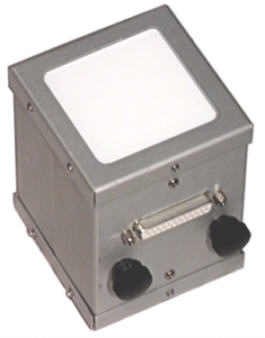 |
- Size of housing - 80 X 80 X 100 mm.
- Made of brushed, anodized aluminum.
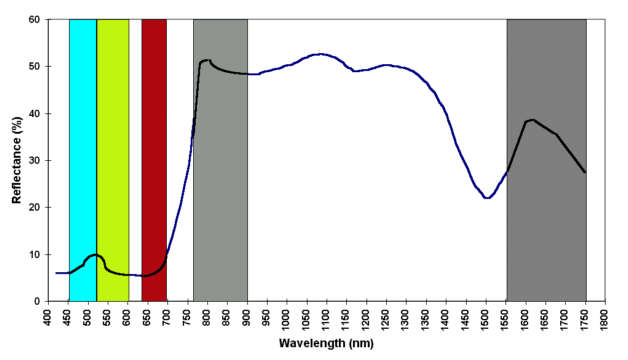
- Interference filter bands similar to Landsat Thematic Mapper:
- 450-520 nm
- 520-600 nm
- 630-690 nm
- 760-900 nm
- 1550-1750 nm
- Flashed opal glass cosine diffuser covers incident irradiance measuring sensors.
- 28 degree field of view for reflected irradiation sensors.
|
| MSR5 Spectral Bands shown over typical green vegetation reflectance |
 |
|
- Size of housing - 80 X 80 X 100 mm.
- Made of brushed, anodized aluminum.
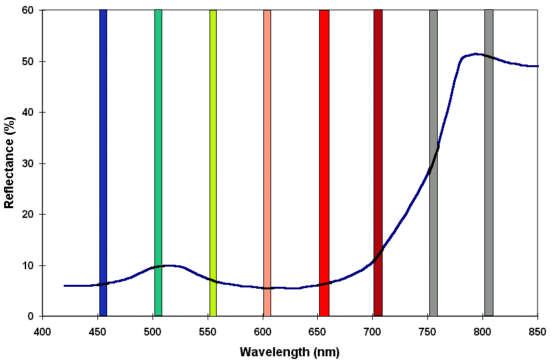
- Standard set of eight narrow band interference filters, centered at:
- 460 nm
- 510 nm
- 560 nm
- 610 nm
- 660 nm
- 710 nm
- 760 nm
- 810 nm
- Flashed opal glass cosine diffuser covers incident irradiance measuring sensors.
- 28 degree field of view for reflected irradiation sensors.
|
| MSR87 Spectral Bands shown over typical green vegetation reflectance |
 |
|
- Size of housing - 80 X 80 X 100 mm, brushed, anodized aluminum.
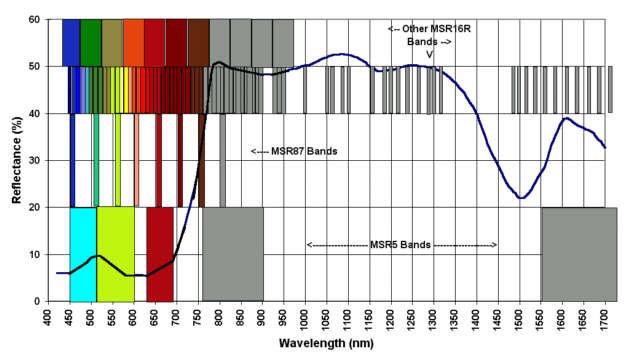
- Accommodates up to 16 bands, in the 450 - 1750 nm region, to measure
incident as well as reflected radiation.
- Can be ordered with down-facing sensors only, if to be used with a white
reference panel (requires clear sky conditions).
- Flashed opal glass cosine diffuser covers incident irradiance measuring sensors.
- The housing is connected to a 32 channel multiplexer module, the MSR Cable
Attachement Box (MSRCAB) by a 25 conductor cable. The MSRCAB is
connected to the DLC by ribbon cables.
|
MSR16R Spectral Bands (approximate visual colors) shown over typical green vegetation
reflectance. (up to a maximum of any 16 of the following may be installed with order or added
later by returning the MSR16R to CROPSCAN, Inc.) |
 |
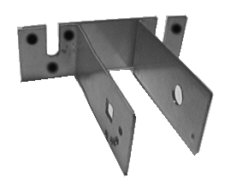 MSRMB
MSRMB
- MSR5, MSR87 or MSR16R Pole Mounting Bracket
- Used to attach the MSR5, MSR87 or MSR16R to the MSR extension support pole.
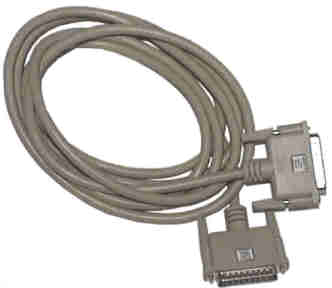 MSR87C-9
- MSR5, MSR87 or MSR16R-to-DLC Cable (9 feet)
- Requires MSRCA (Cable Adapter, below) when used with the DLC.
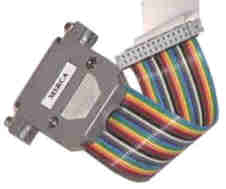 MSRCA
MSRCA
- MSR5 or MSR87-to-DLC Cable Adapter
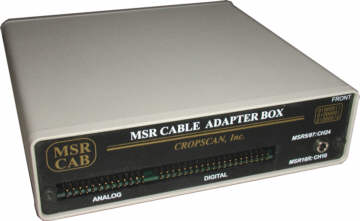 MSRCAB
- MSR5, MSR87 or MSR16R-to-DLC Cable Attachment Box
- Connector Jacks for Six External Sensors (DC voltage output type sensors, one on front panel, five on back)
MSR POLE & POLE ATTACHMENTS:
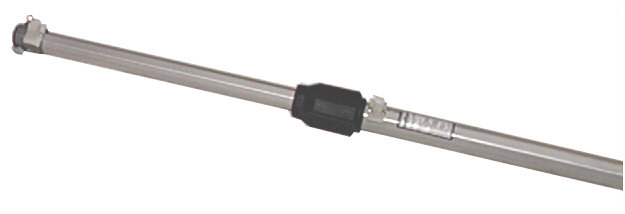 MSRPOLE
- MSR Extension Pole (Extends to 10 feet)
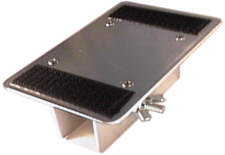 CT100B
- Pole Attachment Bracket for CT100 hand terminal
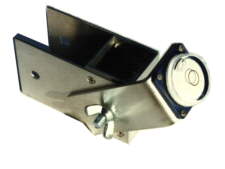 MSRSLA
- MSR Spirit Level Attachment
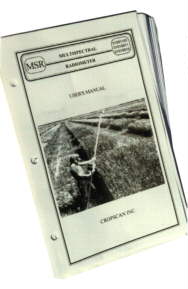 MSRUM - On CD
- MSR Users Manual and Technical Reference (.pdf on CD)
- Includes program and examples files on CD
CALIBRATION
Three methods of calibration are supported for the MSRSYS5, MSRSYS92 and MSRSYS16R systems.
- 2-point - Uses a diffusing opal glass (included with MSR5 or MSR87 or MSR16R purchase), alternately held over the up and down sensors facing the same incident irradiation to calibrate the up and down sensors relative to each other.
Advantages:
- Quick and easy.
- Less equipment required.
- Radiometer may then be used in cloudy or less than ideal sunlight conditions.
- Recalibration required only once or twice per season.
- Assumed radiometer is to be used where irradiant flux density is the same between
that striking the top surface of the radiometer and that striking the target area,
as outside in direct sunlight.
- White Standard Up & Down - Uses a white panel with known spectral reflectance to calibrate the up and down sensors relative to each other.
Advantages:
- Provides a more lambertian reflective surface for calibrating the longer wavelength (above about 1200 nm) down sensors than does the opal glass diffuser of the 2-point method.
- Radiometer may then be used in cloudy or less than ideal sunlight conditions.
- Recalibration required only once or twice per season.
- Assumed radiometer is to be used where irradiant flux density is the same as
that striking the top surface of the radiometer and that striking the target area,
as outside in direct sunlight.
- White Standard Down Only - Uses a white panel with known spectral reflectance with which to compare down sensor readings.
Advantages:
- Only down sensors required, saving cost of purchasing up sensors.
- Best method for radiometer use in greenhouse, under forest canopy or whenever
irradiance flux density is different between that striking the top of the radiometer
and that striking the target area.
Disadvantages:
- White panel must be carried in field and recalibration readings must be taken periodically to compensate for sunangle changes.
- Less convenient and takes time away from field readings.
- Readings cannot be made in cloudy or less than ideal sunlight conditions, because
of likely irradiance change from time of the white panel reading to the time of the sample area
reading.
NOTE: CROPSCAN, Inc. does not provide white calibration reference panels. For our use
in cross-calibration of our 2-point calibrations to a white panel of known reflectance, we use a white
Spectralon panel (12 inches x 12 inches) from Labsphere.
 CROPSCAN, Inc. Home Page
CROPSCAN, Inc.
1932 Viola Heights Lane NE
Rochester, MN 55906 USA
Phone: (507)285-9230
Email: Cropscan@compuserve.com
URL: http://www.cropscan.com
©2017 CROPSCAN, Inc.
all rights reserved
